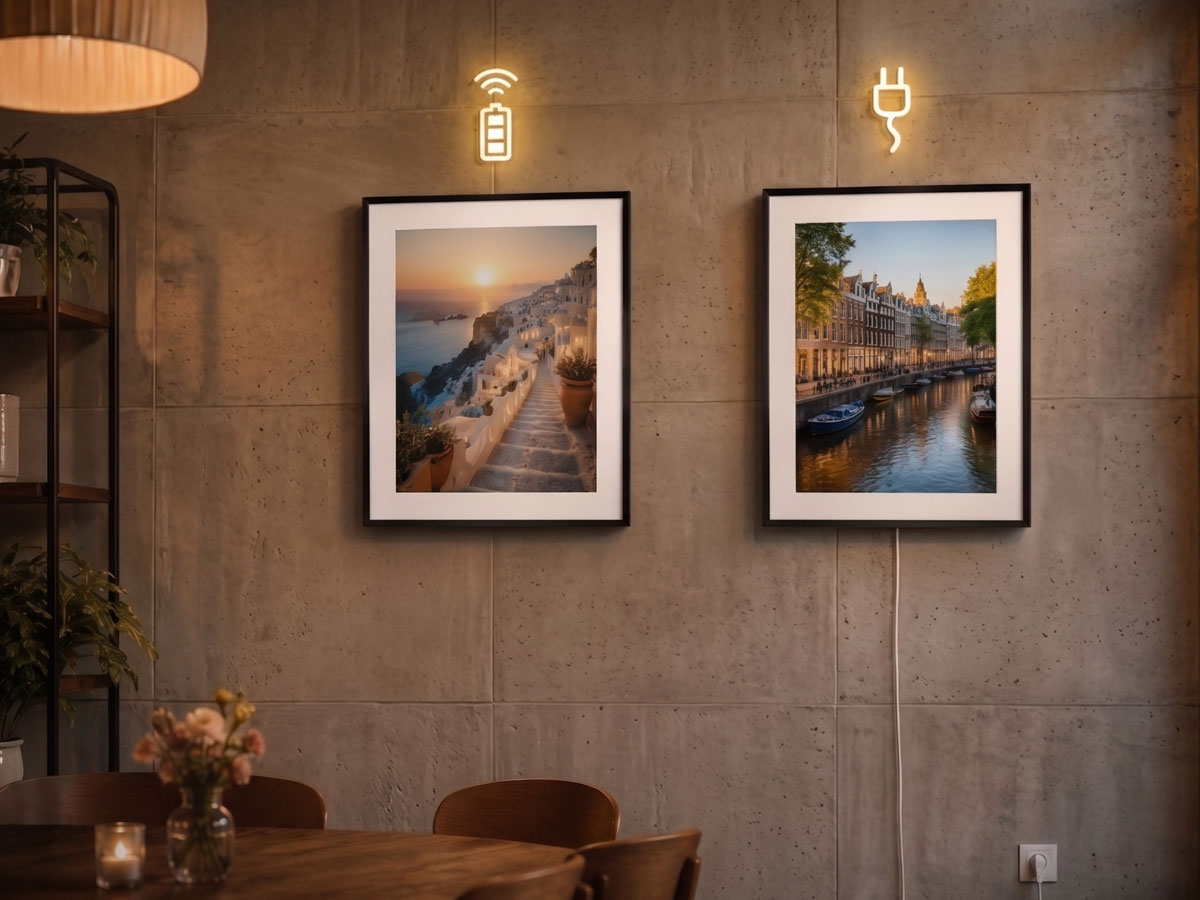
Why a Digital Art Frame Should Not Need Continuous Power
Most digital displays are designed around constant electricity. A television, tablet, monitor, or conventional digital photo frame must remain powered because its screen depends on continuous illumination and electrical control to keep an image visible. Even when the displayed photograph does not change for hours, the device continues consuming energy.
The PixTree E Ink Canvas follows a fundamentally different display model.
Instead of behaving like a small television mounted on the wall, the PixTree E Ink Frame uses reflective electronic paper technology designed for static artwork, family photographs, and long-term home display. Once an image appears on the screen, the display can retain that image even after power is removed. This is the foundation of the product’s ultra-low-power design and the main reason the PixTree E Ink Canvas can operate cordlessly for an extended period.
This capability does not come from battery capacity alone. The PixTree E Ink Canvas includes a 10,000 mAh rechargeable battery, but its long runtime is made possible primarily by the way the display itself works. The product consumes power mainly when changing content, while the image can remain visible without continuous screen power. PixTree’s product specifications describe this directly: the display uses power only when the image changes, the image stays visible when powered off, and the battery is designed for approximately one to three years of use depending on operating conditions and refresh frequency.
The Core Principle: Bistable Electronic Paper
The technology behind power-off image retention is known as bistability.
E Ink’s official technical explanation states that a bistable display can retain an image even when all power sources are removed. In practical terms, electricity is needed when the displayed content changes, but the display does not require continuous power simply to hold the finished image. E Ink identifies this property as a key reason devices using electronic paper can achieve long battery life.
This is very different from the operating principle of an LCD screen.
An LCD relies on an active display system and backlight. The device must continuously power the panel and illuminate the image for the content to remain visible. Once the power is disconnected, the image disappears immediately.
A bistable E Ink display works differently. During an image update, electrical signals move the display’s charged pigment particles into the positions required to form the selected artwork or photograph. After the update is complete, the particles remain stable. The screen no longer needs continuous power to preserve the visible result.
For the PixTree E Ink Canvas, this means a family photo, AI-generated artwork, seasonal illustration, or gallery image can remain on display without the frame continuously drawing energy to maintain it. The product behaves more like a physical print after each refresh, while still preserving the flexibility of digital content.
Why the Image Stays Visible When PixTree Is Powered Off
The phrase image retention after power-off can sound surprising because people are accustomed to LCD and OLED devices. However, on a PixTree E Ink Frame, the retained image is not a software screenshot or temporary memory effect. It is a normal characteristic of bistable electronic paper.
When the PixTree E Ink Canvas receives a new image, the system temporarily activates the screen and completes a refresh cycle. Once the selected picture has been formed, the display holds the image without needing constant electrical input.
This creates a simple power pattern:
- Power is used during an image update.
- Power is not continuously required to keep that image visible.
E Ink’s official FAQ explains that its matrix displays consume power while the display is being updated and do not require power to maintain an image after the update. The company also notes that update power is extremely low compared with continuously powered display technologies.
This is the technical reason the PixTree E Ink Canvas can continue showing artwork after it is switched off or temporarily disconnected from charging. The visible image remains in place because the screen itself is designed to preserve its state.
Why a Large Battery Is Only Part of the Story
The PixTree E Ink Canvas is equipped with a 10,000 mAh battery, giving the product a substantial energy reserve for wireless communication, image processing, system operation, and screen refreshes. However, simply installing a large battery would not create years of practical use if the display required constant illumination.
The real advantage comes from combining the battery with a bistable, ultra-low-power E Ink display.
A conventional digital photo frame may use electricity every second it remains on. The PixTree E Ink Frame concentrates most display-related energy use around content changes. As a result, battery life is strongly influenced by how often users update the screen. A frame showing one artwork for several days or weeks will require fewer refresh cycles than a frame changing images frequently.
This is why the product’s battery-life estimate should be understood as a usage-based range rather than a fixed promise. PixTree’s product information specifies approximately one to three years of battery life, while actual results may vary depending on refresh schedules, wireless activity, connectivity, environmental conditions, and feature usage.
A Cordless E Ink Canvas Designed for Real Homes
The ultra-low-power principle changes more than battery life. It also changes where a digital frame can be placed.
Because the PixTree E Ink Canvas does not need to remain connected to an outlet during normal display, users are not forced to arrange artwork around visible cables or nearby sockets. The frame can be positioned in a living room, bedroom, study, hallway, reading corner, or gallery wall based on the interior design rather than the location of a power source.
That cordless flexibility is central to the identity of the PixTree E Ink Frame. It combines a paper-like visual experience, a non-glowing screen, wireless placement, and digital content control in a form intended to feel more like home décor than consumer electronics. The product also supports personal photos, curated artworks, AI art creation, smart playlists, scheduled content, mobile control, and multiple content sources, supporting PixTree’s positioning as the most fully-featured E Ink frame in the industry.
Why Ultra-Low Power Makes More Sense Than Always-On Displays
When people first hear that the PixTree E Ink Canvas can retain an image after power-off, the next question is usually simple: Why is this useful in everyday life?
The answer lies in how people actually use decorative displays.
Unlike televisions or computer monitors, digital artwork is not expected to change every few seconds. A family portrait may stay on display for weeks. A favorite painting might remain on the wall for an entire season. Holiday decorations often change only a few times each year. In these scenarios, continuously supplying electricity simply to maintain a static image becomes unnecessary.
The PixTree E Ink Canvas approaches the problem differently. Because the display consumes power primarily during image updates, it avoids wasting energy on displaying content that is already complete. Once the refresh finishes, the artwork remains visible while the display itself no longer requires continuous power to preserve the image.
This ultra-low-power operating principle makes the PixTree E Ink Frame fundamentally different from conventional digital photo frames. Rather than functioning like another always-on screen, it behaves much more like a framed print that can be updated whenever you choose.
Less Charging, More Freedom
Battery life is often measured by numbers alone, but the user experience behind those numbers is what truly matters.
The PixTree E Ink Canvas is designed to reduce maintenance rather than simply increase battery capacity. Instead of reminding users to recharge every few weeks or leaving a permanent charging cable connected to the wall, the product’s ultra-low-power display technology significantly extends the time between charging cycles.
Combined with its 10,000 mAh rechargeable battery, the PixTree E Ink Canvas delivers an estimated one to three years of battery life, depending on image refresh frequency and usage patterns. Since power is consumed mainly when the display updates, users who change images occasionally can enjoy exceptionally long cordless operation.
This approach creates a noticeably different ownership experience.
Instead of thinking about battery percentage every day, users simply enjoy their displayed artwork. Instead of planning where a charging cable can reach, they choose where the artwork looks best.
The display technology quietly handles the rest.
Designed Around the Way Homes Really Work
A home’s decoration should be determined by personal taste, not by the location of electrical outlets.
Traditional digital photo frames often remain close to wall sockets because continuous power is required. Visible charging cables can interrupt carefully designed interiors, particularly in minimalist, Scandinavian, modern, or gallery-inspired spaces.
Because the PixTree E Ink Canvas is cordless during normal use, it offers much greater flexibility for placement. A hallway can showcase family memories. A reading corner can display calming illustrations. A bedroom can feature seasonal artwork. A dining room can present rotating photography. None of these spaces need to be organized around permanent power cables.
This wireless freedom complements the product’s other characteristics, including its paper-like, glare-free, non-glowing display. Together, these features allow the PixTree E Ink Frame to blend naturally into the home instead of looking like another electronic device.
The result is a display that feels closer to traditional wall art while preserving the convenience of digital content updates.
Technology That Supports Everyday Moments
The ultra-low-power design of the PixTree E Ink Canvas is valuable because it supports how people actually live.
A family may update photographs after a vacation.
Parents may replace children’s artwork as they grow.
Seasonal decorations can change for holidays without replacing physical prints.
Art lovers can rotate gallery-quality images whenever inspiration strikes.
Gift givers can preload meaningful photographs and personal messages before presenting the frame, allowing the recipient to experience a personalized display immediately after opening the package.
All of these experiences are made possible because the PixTree E Ink Canvas combines flexible digital content with an energy-efficient display architecture. The frame supports personal photos, AI-generated artwork, curated galleries, Google Photos and iCloud integration, smart playlists, scheduled content, mobile applications, and multi-user sharing, while maintaining the paper-like qualities that distinguish electronic paper from conventional displays.
Rather than asking users to adapt to technology, the product is designed to integrate naturally into daily routines and home environments.
More Than Long Battery Life
It would be easy to describe the PixTree E Ink Canvas simply as an E Ink frame with years of battery life, but that description tells only part of the story.
The product combines multiple characteristics that work together:
- A paper-like Color E Ink display that reflects ambient light.
- A glare-free, non-glowing viewing experience that feels more like printed artwork.
- Ultra-low-power operation enabled by bistable electronic paper technology.
- Image retention after power-off, eliminating unnecessary continuous energy consumption.
- Completely cordless placement, making it easier to decorate real living spaces.
- Rich content features, including AI art creation, mobile synchronization, cloud photo integration, scheduled playlists, and privacy-focused transfer options.
Together, these capabilities support PixTree’s vision of creating the most fully-featured E Ink frame in the industry, combining advanced display technology with practical everyday usability and home aesthetics.
Frequently Asked Questions
Why can the PixTree E Ink Canvas keep an image after power-off?
The PixTree E Ink Canvas uses bistable electronic paper technology. The display consumes power primarily when refreshing the image. Once the update is complete, the image remains visible without requiring continuous display power.
Does the PixTree E Ink Canvas consume power while displaying the same picture?
The display itself does not require continuous power to maintain a completed image. Energy is mainly consumed during image updates, while additional system functions such as wireless connectivity may use power according to their operating status.
Why can the battery last for years?
The combination of bistable E Ink technology and a 10,000 mAh battery allows the PixTree E Ink Canvas to operate with extremely low display power consumption. Actual battery life depends on factors such as image refresh frequency, wireless activity, and usage patterns.
Is the PixTree E Ink Canvas intended to replace a TV?
No. The PixTree E Ink Canvas is designed for displaying artwork, photography, memories, and decorative content over long periods. It is optimized for paper-like visual presentation and ultra-low power consumption rather than video playback.
Conclusion
Many electronic devices have become faster, brighter, and more powerful over the years. The PixTree E Ink Canvas takes a different approach by asking a simpler question: Should a picture that never changes continue consuming electricity every second?
Thanks to bistable Color E Ink technology, the answer is no.
By using power primarily when content changes and retaining the image after power-off, the PixTree E Ink Canvas achieves an ultra-low-power display architecture that supports long battery life, cordless installation, and a quieter relationship between technology and the home.
Combined with its paper-like, glare-free, and non-glowing viewing experience, this technology transforms digital artwork from another illuminated screen into something that feels much closer to a traditional framed print.
For homeowners, art enthusiasts, and thoughtful gift givers alike, the PixTree E Ink Canvas demonstrates that innovation is not always about making displays brighter. Sometimes, it is about making them calmer, more energy-efficient, and better suited to the way people truly live.